


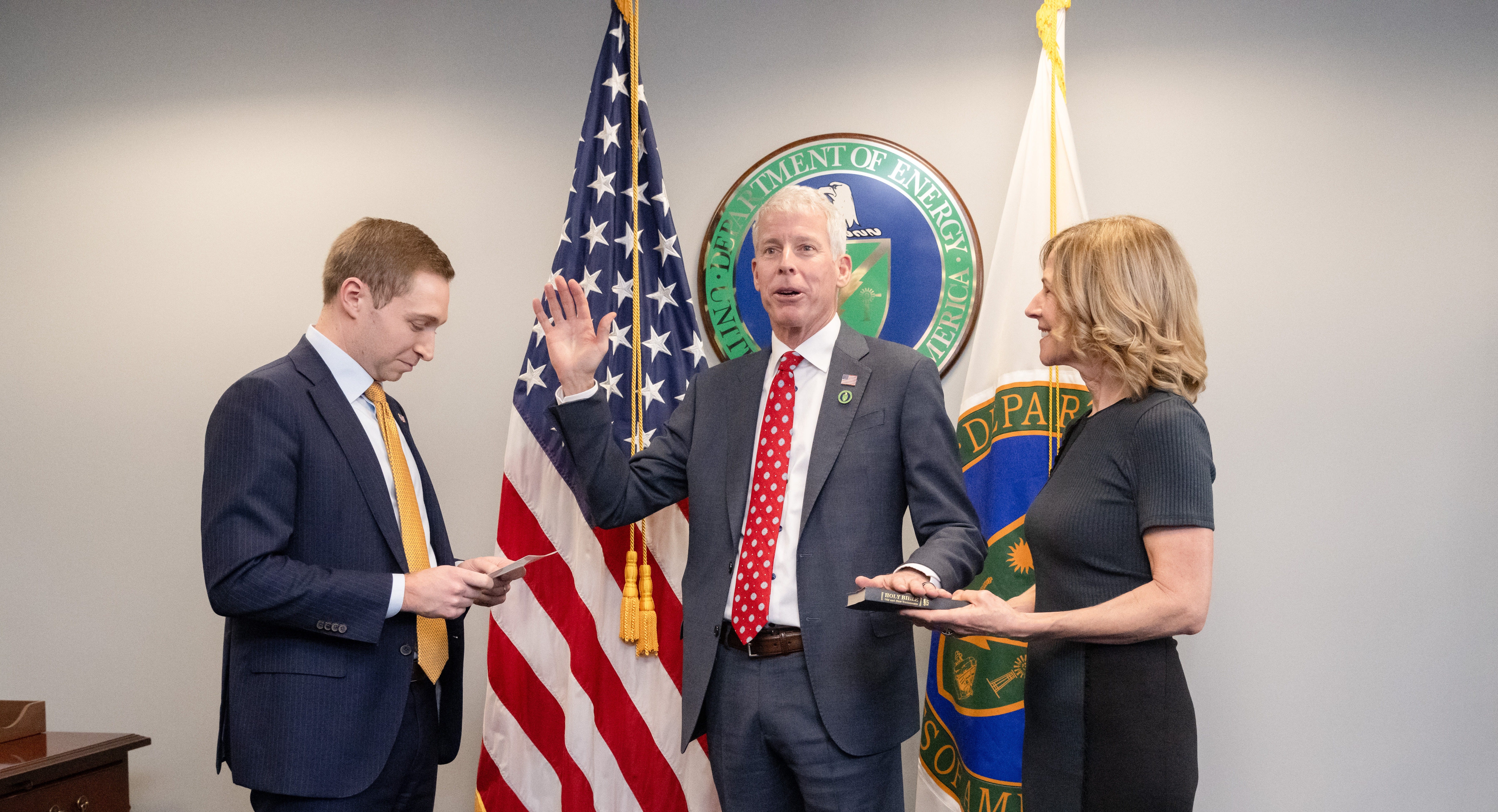
In its first year in office, the second Trump administration declared all-out war on solar energy. It began as soon as Trump took office, with day-one executive orders targeting renewables.1 The fight then moved to Congress, which took aim at solar subsidies in Biden’s Inflation Reduction Act (IRA).
In crafting this legislation, Congressional Republicans went out of their way to consult Alex Epstein, the clownish, inaniloquent author of Fossil Future: Why Global Human Flourishing Requires More Oil, Coal, and Natural Gas–Not Less.2 Epstein, a self-described “philosopher,” has no education or experience in energy policy, yet nonetheless markets himself to morons as a sort of energy guru. Epstein’s worst ideas were filtered out of the One Big Beautiful Bill (OBBB) before final passage. Nevertheless, the IRA’s generous subsidies for solar were repealed and phased out over time.3
In August, the Interior Department issued a new order that effectively banned wind and solar development on federal lands, placing gigawatts of solar generation capacity at risk.4 The disjointed, vitriolic prose of the order revealed its authors had been mainlining anti-renewable disinformation the way early 2000s Charlie Sheen mainlined cocaine.
Trump’s Energy Secretary, Chris Wright, seems to inject the stuff directly into his carotid arteries. A former fracking executive, it was thought that Wright would at the very least bring some level of knowledge and competency to the post. Yet in office, Wright has done everything possible to prove this presumption wrong - routinely exhibiting his ignorance of fundamental energy concepts. In September, Wright made perhaps the dumbest comment ever made about solar energy in this faceplant of a Twitter post:
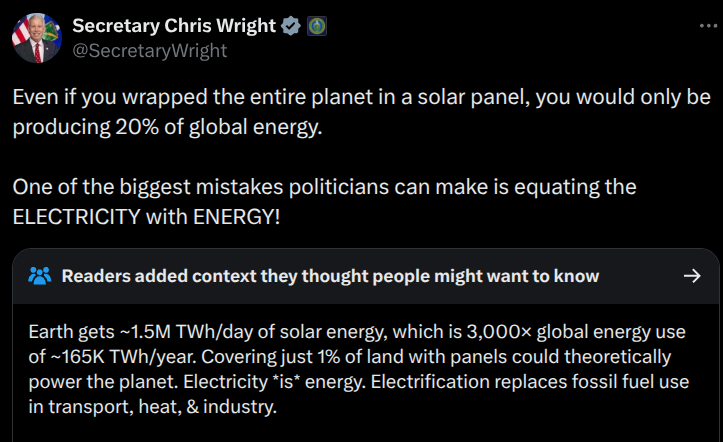
The post was roundly mocked and quickly debunked. But it highlighted again how many appointees within the administration have been brainwashed by the most basic, intellectually rancid disinformation about renewables. And personnel, as ever, is policy.
In December, the administration fired 130 employees of the National Renewable Energy Laboratory (NREL), a leading institution of solar energy research, and - in a particularly petty move - changed its name to the “National Lab of the Rockies”.5
The conflict has been ugly and the tactics at times thuggish. Yet thirteen months into the War on Solar, one thing is abundantly clear: it hasn’t worked. In 2025, developers added 29.2 GW of utility-scale solar generation capacity to the grid, just a shade lower than the 31.2 GW added in 2024.6 Trump’s own Energy Information Administration (EIA) predicts a record 43.4 GW of new utility-scale solar will come online this year.7
By the end of 2026, solar is expected to make up 70.6% of all electricity generation capacity additions in the first half of Trump’s second term. Wind will make up another 17%. And fossil gas will be a distant third at 11%.8
They came for the king. And they missed.
If You Can’t Beat ‘Em…
From the very beginning, the second Trump administration’s energy policy has contained a fundamental contradiction: it is impossible to meet rising electricity demand from AI data centers and other sources of load growth without aggressively expanding solar energy.
From their public communications, it is clear that the bureaucrats currently running the United States’ energy policy would prefer all the nation’s electricity to be generated by coal, fossil gas, and nuclear. But this romantic quest to reconstruct the energy system of the 1970s is deeply at odds with the economic realities of the 21st century.
Coal is the most polluting fossil fuel, both in terms of carbon emissions and air pollution, and coal plants are extremely expensive to build. Additionally, no one would dare construct one even if it were economic for fear a future Democratic administration would force its closure. Fossil gas has a much larger social license than coal. Gas turbines, however, are made by a small number of specialized engineering firms who cannot fill orders fast enough. The backlog is several years long, relegating gas to marginal player status for at least half a decade. And the timescales on nuclear plants are even worse; they can take up to fifteen years to construct.
Solar and batteries, on the other hand, are cheap and plants can be constructed in a matter of months. They are the only technologies capable of providing large amounts of capacity quickly to meet surging AI demand.
Belatedly, the Trump administration appears to be waking up to this reality. Recent reports indicate that at least twenty large solar projects that had been stalled since early 2025 have been suddenly given permitting approvals in recent weeks.9 And communication around energy issues has markedly changed too, even at the very top. In this year’s State of the Union address, Trump himself embraced the concept of “Bring Your Own Power” (BYOP), announcing to the nation: “We're telling the major tech companies that they have the obligation to provide for their own power needs.”
Trump’s call for BYOP did not specifically mention that new capacity should be solar or even low-carbon. But presuming recent trends continue, these data centers will in fact be powered primarily by solar and batteries, along with smaller amounts of fossil gas and wind. It is also notable that Trump did not take the opportunity to disparage wind and solar or blame them for rate increases - as he has often done in the past. His statement was technology neutral.
Trump’s solar thaw increasingly reflects the views of his own voters. Although Republicans consistently tell pollsters they are against subsidies for solar, they are also against artificial constraints on the technology of the sort the administration relentlessly pursued in 2025. A recent poll found that 75% of Trump voters agreed with the statement that “solar energy should be used in the US to strengthen and increase our energy supply.”10
Camp des Ensoleillés
There even exists a growing aggressively pro-solar faction within Trump’s Make America Great Again (MAGA) movement. One of the more jarring manifestations of this phenomenon has been Katie Miller, an über-MAGA influencer and wife of Trump senior advisor and immigration hardliner Stephen Miller. In recent months, Ms. Miller has become a solar-pilled renewable energy hypewoman on social media, regularly making posts such as the following on Twitter:

Miller’s advocacy has been so out of character for a hardcore MAGA Republican, she has been forced to deny the accusation she is being paid by the solar lobby.11 Her beliefs are, indeed, likely to be genuine and originate from her close association with Elon Musk and other pro-solar tech oligarchs.
This pro-solar faction of MAGA is less interested in the climate benefits of solar energy, and is motivated rather by a mixture of geopolitics and sci-fi futurism. The awesome, inimitable power of the sun’s fusion reactor makes solar PV the future of energy, they argue, and the United States is falling behind China in the increasingly strategic industry of harvesting electrons. A powerful chunk of Trump’s coalition - the TechBros - has defected from its fossil-first energy policy.
Soon, efforts to undo the Trump administration’s first-year anti-solar policies could be coming both from within his coalition and from a newly-empowered political opposition. 2027 is predicted to bring Democratic majorities in Congress, and Democrats may use their budgetary and oversight powers to limit any remaining anti-solar measures.
Forecasters predict that beyond 2026, solar capacity additions will flatline or even tumble as subsidies expire.12 These forecasters are likely to be wrong. Electricity demand is still growing. Solar is still the cheapest form of generation. Batteries are tumbling in price. And with gas turbines hard to come by and nuclear plants decades away - hyperscalers are willing to pay for clean, quick-to-market generation capacity.
The summer of 2025 may have been the high-water mark of the anti-solar movement in the United States. The most rabidly anti-solar administration in American history took power, and the best they could do was mildly slow solar energy’s growth - and then capitulate.
Get Earthview in your inbox:
And consider a paid subscription to get premium analysis and support the work we do!
Ibid.