


Elon Musk’s xAI is doubling its fleet of highly polluting gas generators at its Mississippi data center, reports Canary Media. Musk — once hailed as a climate champion — is using legal loopholes to get around air pollution regulations.
Because the state considers them “mobile” turbines — they’re attached to flatbed trailers — MDEQ allows xAI to run the generators without an air permit for up to a year. But Southaven residents and advocates have pushed back, expressing concerns over unchecked air emissions and constant noise from the generators.
2. US Plans Drastic Water Cuts on Colorado River
The US federal government is planning severe cuts to Colorado River water supplies, explains Reuters. Several Western states rely on the Colorado River’s water — primarily for agriculture — but its levels are threatened by wasteful management, drought, and climate change.
The maximum possible federal cuts, which would be reviewed every two years based on water levels, are nearly twice as large as a May 1 offer by those three lower-basin states to reduce their water use by 1.6 million acre-feet per year.
3. No Sign Yet of US EV Boom
The Iran War has stimulated electric vehicle (EV) sales in many nations — but so far the United States is not among them, according to Cox Automotive.
…research indicates that while higher gas prices are driving increased interest in fuel-efficient vehicles, most shoppers continue to gravitate toward fuel-efficient gas vehicles and hybrids rather than EVs.
It’s too early to be certain. In the fullness of time, high gasoline prices may yet stimulate EV sales in the US. – DB
Our Blue Marble

Geirangerfjord | Norway
Good Climate News
1. Offshore Wind Booms Outside US
The offshore wind energy business is booming worldwide despite a slowdown in the US, notes The Associated Press. Political shortsightedness means the US is missing out on a clean, reliable energy source — but smarter nations are moving on regardless.
Globally, countries added enough offshore wind energy to power 10.2 million homes in 2025 alone. The total was nearly 9.3 gigawatts, an increase of 16% over the previous year… The amount of offshore wind currently installed globally can produce enough energy to power the equivalent of 102 million homes, according to GWEC’s calculations.
2. World’s Smallest Island Nation Goes Solar
The tiniest island nation in the world — Nauru — is ditching diesel generation for solar, relays PV Magazine. An Australian company intends to build an 18 MW solar farm along with 40 MWh of storage — enough to provide 2/3 of the country’s electricity.
…[Nauru] remains heavily dependent on imported diesel for electricity generation, consuming an estimated 7–8 million liters annually, however SCE’s solution would improve energy security.
Island nations are among the most exposed to the Iran War energy crisis. Expect more of these “let’s get off diesel” deals in the coming months. – DB
3. Heat Pumps Dominate Sales in Europe
The Iran War and incentive schemes are propelling clean, climate-friendly heat pumps to market dominance in Europe, heralds Euro News. Nearly 50% of new heating systems sold in Germany are now heat pumps, and even the historically lagging UK has seen a sales surge.
…heat pump sales grew by 10.3 per cent across 16 European countries on average in 2025. 2.62 million residential units were sold during this period, bringing the total to 28 million across the continent.
Book of the Week

Wild Ocean: A Journey to the Earth’s Last Wild Coasts | Peter Pickford & Beverly Pickford
The authors of Wild Ocean spent four years traversing the wildest, most pristine coastlines across all five of Earth’s oceans, and the result is 400 pages of stunning landscape and wildlife photography. This book is the ultimate visual record of the liminal space between Earth and Sea in its most natural state. A pictorial joy to savor and contemplate. –DB
In Brief
🇪🇺 Europe: The European Parliament has delayed implementation of the bloc’s landmark anti-deforestation law by another year.
🇫🇯 Fiji: Fijians are fighting back against plans for a waste-to-energy plant that could provide 40% of the country’s electricity, but at the cost of a massive increase in air pollution.
🇮🇳 India: An extreme heat wave is exposing India’s unpreparedness for the higher temperatures expected in future due to climate change. Only 8% of the nation’s people have air conditioning.
🇮🇷 Iran: The stunningly biodiverse ecology of the Strait of Hormuz is under threat from the ongoing conflict between Iran, the United States and Israel.
Planetary Pulse
Planetary Health — Latest figures
CO2: 432.24 PPM (+1.79 YoY)1 | Temperature Anomaly: +1.48 C
Forest Cover: 31.8% | Protected Areas: 12.3% (17.3% terrestrial, 10.01% marine)
Emissions per Capita: 4.89 (World) | 9.1 (China) | 13.1 (USA) | 6.1 (EU) | 2.1 (India)
Low Carbon Electricity: 43.1% | Low Carbon Energy: 19.8% | EV New Sales : 24.1%2
The Other 74%
Papua New Guinea has announced the creation of its largest-ever Marine Protected Area — which will preserve an area about the size of the UK.
Four major conservation groups have united to push for a Jaguar Rivers Initiative — an attempt to protect a highly biodiverse riparian ecosystem shared between Argentina, Bolivia, Brazil, and Paraguay.
Researchers at WHOI have developed an advanced autonomous underwater robot capable of mapping coral reefs with unprecedented precision.
Los Angeles will be installing “trash interceptors” along its rivers to catch garbage before it is discharged into the ocean.
Meet the Endangered
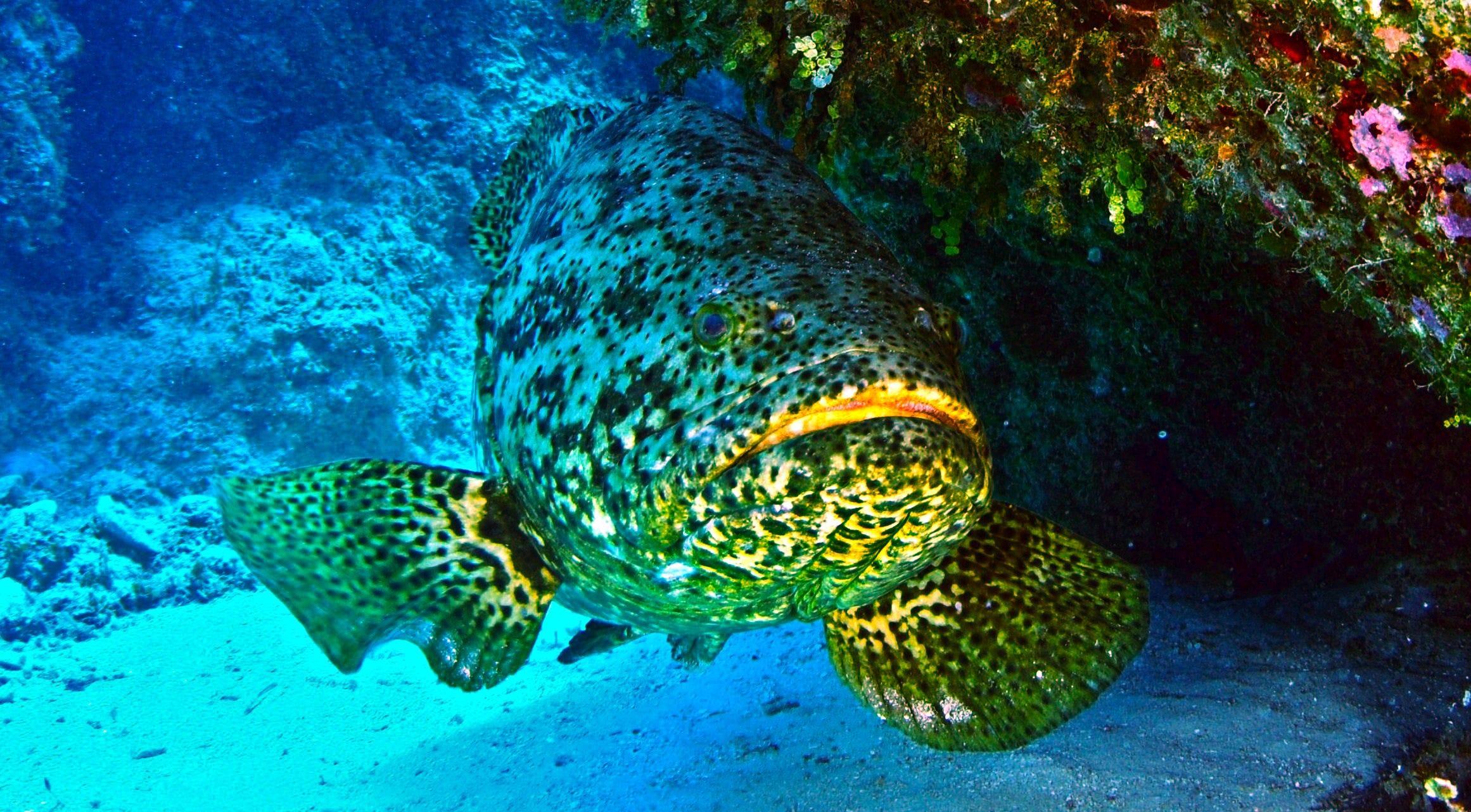
Atlantic Goliath Grouper (Epinephelus itajara)
The average grouper species weighs between 10 and 20 lbs. The massive Atlantic Goliath Grouper, on the other hand, can reach 363 kg (800 lbs) and 2.5 m (8 ft) in length, or roughly the size of a grand piano. The fish primarily ranges from Florida, through the Caribbean, and down the Atlantic coast of Brazil, with additional populations in West Africa and the Pacific side of Central America.
The Goliath is a bottom feeder, using its powerful mouth to suction calico crabs, spiny lobsters, and smaller fish off the ocean floor. As an adult, it indwells the placid environments of reefs and shipwrecks, and is commonly encountered by divers.
The greatest menace to the Atlantic Goliath Grouper is overfishing - a peril supercharged by the fish’s aeonian generation length of 21.5 years. Another is the destruction of mangroves, which it uses as a nursery habitat. The species has been protected in the United States since 1990, and has experienced a significant rebound in American waters. It remains critically endangered in Brazil.
IUCN: Vulnerable (VU)
The Weekly Combustion
My regular, scorched-Earth rant countering anti-environmentalist rhetoric and exposing the grifters who profit while our planet burns. Available to paid subscribers.
