


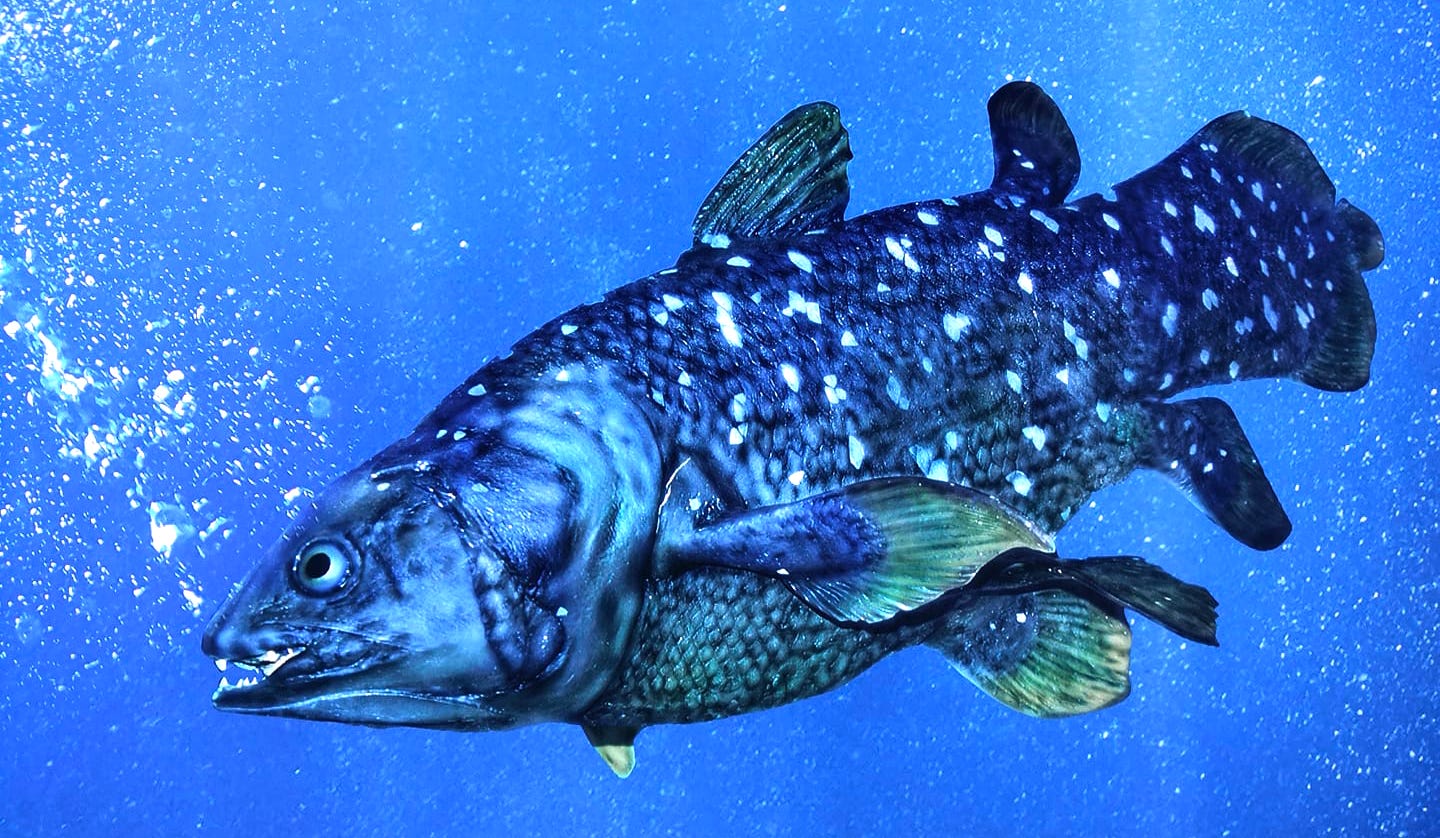
West Indian Ocean Coelacanth (Latimeria chalumnae)
Paleontologists have known about coelacanths since the early 19th century, as the lobe-finned fish appear amply in the fossil record. But their fossil trail died out around 66 million years ago when the Cretaceous-Paleogene (K-Pg) extinction event killed the non-avian dinosaurs, and so coelacanths too were presumed to be extinct.
Astonishingly, in 1938, a living coelacanth was discovered off the coast of South Africa, and the West Indian Ocean Coelacanth is now known to inhabit several spots in the seas off Madagascar, the Comoros, and Mozambique. It was later joined by the discovery of a separate Indonesian species (Latimeria menadoensis) in the late 1990s.
The coelacanth is the earliest and best-known example of a ‘living fossil’ - a species or genus that represents the sole remaining member of a much broader taxon, otherwise known only from fossils. Coelacanths are more closely related to tetrapods (amphibians, reptiles, birds and mammals) than to most other living fish, offering a glimpse back in time to our own evolutionary path.
Fewer than 500 of the West Indian variety remain; even fewer of the Indonesian. Capture as bycatch is rare, but nonetheless remains the single greatest threat to the Coelacanth’s survival. Many local fishermen have been trained to return this ancient fish to the abyss that has sheltered it for 66 million years.
IUCN: Critically Endangered (CR)
Sign up to get Earthview in your inbox:
And consider a paid subscription to get premium analysis and support the work we’re doing!