


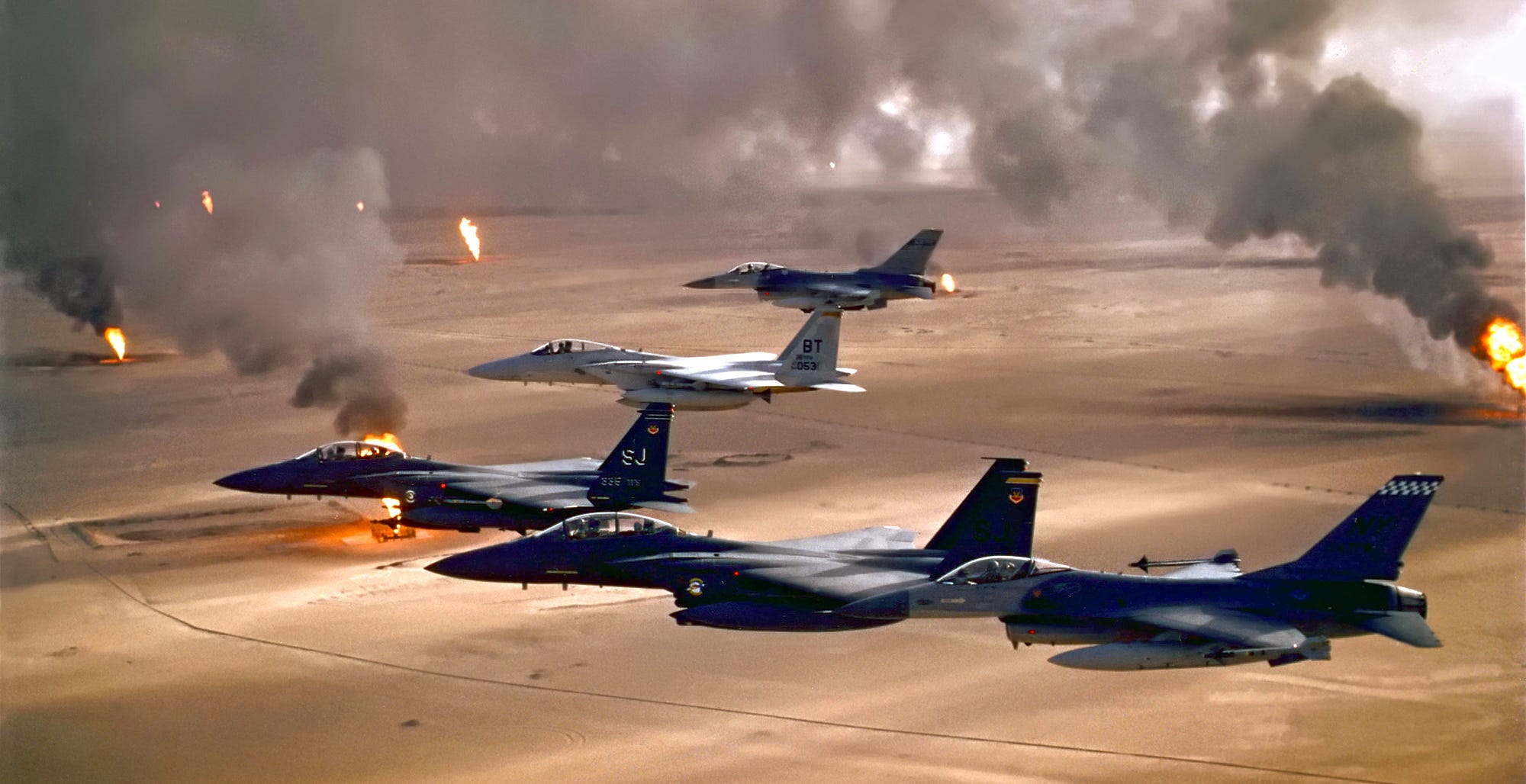
In the early 2000s, the Iraq War raged and mass-market electric vehicles (EVs) remained a distant dream. At the time, the link between the two was obvious. The United States had invaded the country with the world’s fourth-largest oil reserves to offset its own dwindling production. If the world could somehow develop vehicles that ran on electricity instead of petrol, “blood for oil” would be a thing of the past.
Nearly a quarter-century later, much has changed. The Iraq War is over, ending in a withdrawal that largely preserved the status quo ante bellum at the cost of between 150,000 and 450,000 deaths.1 Meanwhile, fracking has made the United States the world’s largest oil producer.
At the same time, electric vehicles are commonplace - representing about half of all sales in China, about a quarter in Europe, and a tenth in the United States. EVs are prized for their superior acceleration, low fuel costs, and lack of tailpipe emissions. Yet the ability of EVs to make the world more peaceful has vanished from public discourse and is no longer a primary selling point in the marketplace.
It should be.
The hundreds of thousands of American, British, Australian, and other coalition soldiers who once occupied Iraq have come home. But the Oil Wars never really went away; they merely mutated and migrated to other parts of the world. From Venezuela to Yemen, Ukraine, Sudan, and Iran - conflicts fueled by oil consumption still blaze, smolder, and seethe across our Planet.
Sang de terre
Crude oil has a number of characteristics that make it likelier to provoke conflict than renewables like wind and solar. It is excludable, meaning one party can prevent another from drilling for oil in a way they cannot, for example, block the sun. It has an uneven distribution across the globe, creating mismatches between supply and demand. And it is fungible - a barrel of oil can be transported and sold easily to any market.
Perhaps its most dangerous feature is fuel-dependency. Modern industrial nations need a constant supply of oil to feed their economies and any disruption creates economic, social, and political turmoil. Developed nations are willing to threaten or engage in war to prevent this outcome. War is also expensive, and the high rents from oil production also finance wars that authoritarian regimes would otherwise be unable to afford.
Iran is a unique example of both such dangers. Its status as one of the world’s premier oil producers made it the object of great-power conflict throughout the 20th century - first between the United Kingdom and Russia and then between the United States and the Soviet Union.
In the post-Cold War period, not much has changed. Iran is perpetually threatened with regime change by Western powers who tolerate similarly autocratic (yet oil-poor) nations just fine. Additionally, since the Islamic Revolution of 1979, Iran has used oil revenues to finance an oppressive internal security state and proxy wars abroad in places like Lebanon, Iraq, Syria, and Yemen.
Get Earthview in your inbox:
And consider a paid subscription to access premium content and support the work we do!
Yemen’s current civil war is a horrific example of an oil war. It started in 2014, and since that time has fractured the nation’s territorial integrity and killed at least 377,000 people.2 It is a three-sided conflict that is entirely financed by three separate petrostates: Saudi Arabia, the United Arab Emirates (UAE), and Iran, none of whom would be capable of sustaining such expensive military adventures were it not for oil.
The Russo-Ukraine War - the largest in Europe since World War II - would also have been impossible without fossil fuels. Ukraine does not have significant amounts of oil or fossil gas. But from 2000 to 2022, Europe spent approximately $2.5 trillion purchasing oil and gas from Russia.3 Russia took that money, used it to build up its armed forces, and then finance a war of conquest in Ukraine.
Over a million people have been killed or wounded in the Russo-Ukraine War since 2022.4 In addition to this human toll, Europe is spending hundreds of billions of dollars on aid to Ukraine and hundreds of billions more to bolster its own armed forces - all to defend the continent from a Russian army for which it also paid.
Harvard University’s Belfer Center estimates that between a quarter and a half of interstate wars are linked to oil.5 In addition to Yemen and Ukraine, oil conflict is currently raging or brewing in Sudan, Libya, and Venezuela - which over the past year has both fended off invasion threats from the United States and threatened to invade its neighbor Guyana to seize its oil wealth.
Petroleum delendum est
The enormous waste of life and wealth associated with oil wars could be avoided altogether by switching to electric vehicles. About half of crude oil demand comes from road vehicles. This rises to two-thirds if other uses in the transport sector, like aviation and marine fuels, are included. The remainder is used mostly for plastics and petrochemicals.
A fully electrified road transport sector would not make crude oil worthless. Rather, it would transform oil into a much less valuable commodity - relegating it to the same strategic tier as materials like copper or bauxite. The conquest of oil-producing regions would be less desirable and autocratic regimes like Russia and Iran would be deprived of revenues they need to survive.
The new order wouldn’t be perfect. The geography of production costs means oil production in an all-EV world would concentrate in Saudi Arabia and the Gulf States. But these thoroughly unideal producers would be selling a much less of a cheaper, less vital commodity. And some of the world’s worst petrostates - especially Russia and Venezuela - would be impacted more deeply.
Electric vehicles themselves rely on the procurement of certain strategic metals like copper, lithium, and the so-called “rare earth” group metals. But there is no danger of swapping one dependency for another. The ability of oil to hold markets hostage is linked to fuel dependency. And EVs are fueled by electricity, which can be generated in myriad ways and typically from domestic sources.
For the sake of geopolitical stability alone, the EV revolution should be accelerated. China and Europe should supercharge their respective electric vehicle transitions with more aggressive policy support and even start to retire their gasoline fleets with “cash for clunkers” schemes.
In the United States, policy options are constrained by Republican control of the federal government. States, however, should introduce incentives of their own. They should also look to remedy non-financial barriers that hurt EV adoption - like outdated dealership laws that prevent EV manufacturers from selling directly to consumers.
When Democratic governance resumes at the federal level, the US should resurrect EV tax credits like those in Biden’s Inflation Reduction Act (IRA). It should also open its domestic market to Chinese EV makers (or at least use the threat of doing so as a cudgel to incentivize American automakers to transition to electric drivetrains more quickly.)
But governments don’t have to do everything. The automobile market is directly consumer-facing, which offers the average person a unique opportunity:
If you care about peace in the world - choose an EV. It will make a difference.
And consider a paid subscription to access premium content and support the work we do!