


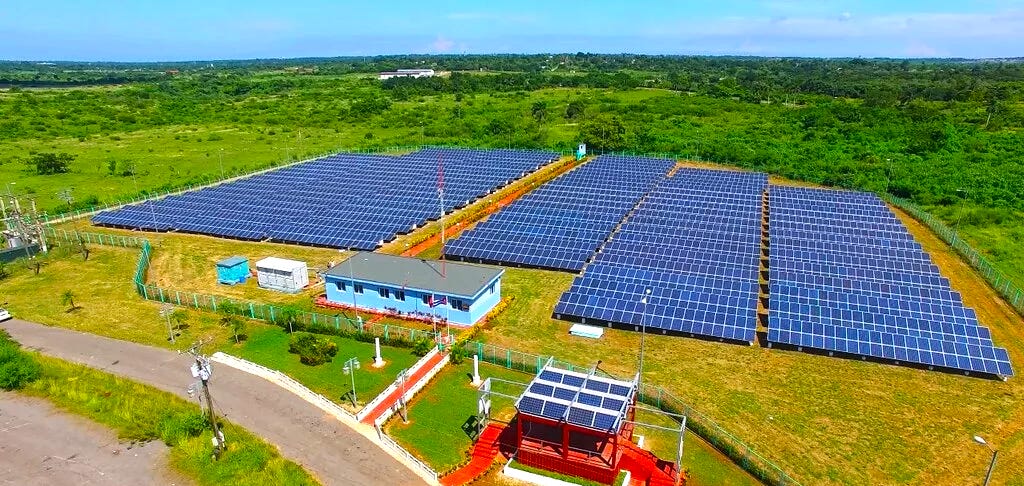
The Caribbean island nation of Cuba is turning to solar energy to help it survive a throttling oil blockade imposed upon it by the United States - its chief geopolitical nemesis.
Since the early 2000s, Cuba has depended on subsidized oil imports from its ally Venezuela for the vast majority of its energy. Cuba not only uses oil for road transport, but also to generate electricity - a rare practice that is far more typical of oil producers than oil importers. In recent years, 80% of Cuba’s electricity has come from burning oil.1
For a long time, the arrangement made a certain amount of sense. Cuba and Venezuela are both left-wing dictatorships antagonistic to the United States. Relatively cheap energy was one of the few tangible benefits Cuba could offer its population. Cuba traded its security expertise for oil, even providing bodyguards to Venezuelan president Nicolás Maduro.
But over the last few decades the economically illiterate, kleptocratic regime in Caracas has slowly ground Venezuela’s economy into dust. Unable to maintain high levels of oil production, Venezuela was forced to significantly cut Cuba’s oil allocation, which peaked in 2012.
Already reeling, the United States then turned the screws. Since Donald Trump’s inauguration in January 2025, the US has pushed hard for regime change in Havana - an effort led by Secretary of State Marco Rubio, a first-generation Cuban-American. On December, 17th 2025, the US began to blockade oil tankers transiting to and from Venezuela, effectively ending Venezuelan oil exports to any country.
On January 3rd of this year, American special forces captured President Maduro in a dramatic nighttime raid, overpowering his Cuban bodyguards and rendering the chavista in chief to the United States for trial. This thundering, ferine invocation of military force has given the Trump administration leverage over the rump government of acting president Delcy Rodriguez, who has - perhaps not coincidentally - subsequently agreed to open her nation’s oil sector to foreign investment.2
Venezuela’s oil deliveries to Cuba have plummeted to zero. Additionally, the US has used diplomatic pressure to prevent Mexico - Cuba’s other important oil provider - from filling the gap.3 Cuba is running out of oil. In the past few weeks blackouts lasting up to 24 hours have become commonplace.4 Public transport has ground to a halt. Foreign airlines have stopped serving Havana’s airport, for fear they might not be able to procure enough fuel for the return trip.5
Cuando Calienta el Sol
The Cuban government has belatedly recognized the perils of fossil fuel dependency. A few years ago, when Venezuelan oil was running low, it committed itself to switching to solar energy and began building a series of solar farms. Those efforts have accelerated in recent months as the American blockade turned a unfavorable situation into a calamity.
The goal is to build 92 solar farms by 2028, 35 of which have been completed as of last October.6 These farms use Chinese solar panels, often donated or bartered by Beijing to the cash-strapped Cuban regime. The requisite kit arrives in standard container ships, very much unlike oil - which transits via conspicuous, easily blockadable oil tankers.
The solar revolution is also happening from the bottom-up. As blackouts sweep the island, fuel for the diesel backup generators that once provided relief is also in short supply. So middle class Cubans, particularly those who receive remittances from abroad, have been buying solar panels for their own residential use.7
All together, solar managed to generate about 7% of the nation’s electricity in the final half of 2025 - a sharp increase from only 3% in the first half. This is not nearly enough generation to salve Cuba’s woes. But perhaps, with further expansion, it will be enough to stave off collapse.
If the Castro regime were to fall due to this energy crisis, it may - in the end - be no bad thing for the world or the Cuban people. Since the Cuban Revolution of 1959, the island’s communist authorities have impoverished the once-prosperous nation, suppressed political dissent, and exported its bloody revolutionary tactics to other nations in Latin America and Africa.
From the perspective of the Cuban government, however, the pivot to solar is something that clearly should have been done much sooner. Reliance on a dirty fossil energy system left Cuba extraordinarily vulnerable to its adversaries, fostering an energy emergency that may yet topple its leadership.
Other fossil-dependent countries should take note. Unfriendly nations may be able to block oil tankers: they cannot block the sun.
Sign up to get Earthview in your inbox:
And consider a paid subscription to get premium analysis and support the work we do!
https://www.powermag.com/cuba-accelerates-solar-expansion-with-2000-mw-plan-by-2028/