


Canadians pride themselves on being a moral example to the rest of the world. When, in the 1800s, the United States viciously enslaved its African-American population, Canada welcomed escaped refugees with open arms via the Underground Railroad.1 And today—while their loutish cousins to the south invade sovereign states and execute regime-change operations around the world—Ottawa floods conflict zones with neutral, UN-helmeted peacekeepers.
Every year, Canada resettles more refugees per capita than any other wealthy nation. Via the Ottawa Treaty, it led the global effort to ban landmines. It was also an original co-author of the Universal Declaration of Human Rights.
There is one humanitarian issue, however, on which the Great White North is a severe laggard relative to its peers: climate change. Canada’s carbon emissions are among the highest in the world on a per capita basis. In 2024, Canada’s CO2 emissions per capita were 13.42 tonnes, nearly three times those of the UK, six times those of India, and roughly on par with the United States.
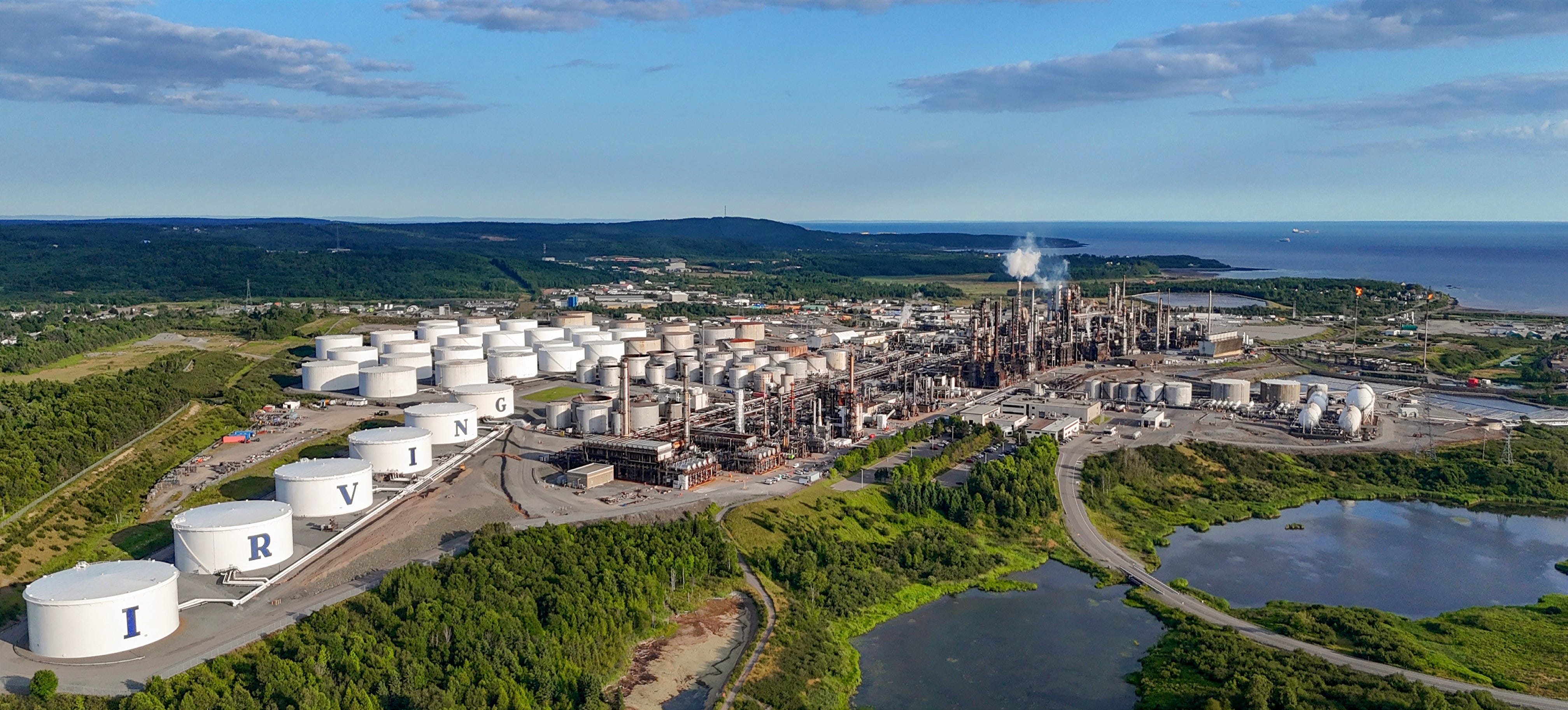
These dismal numbers are unlikely to improve anytime soon. Since Prime Minister Mark Carney came to office last year, he has executed a slow but deliberate pivot away from the pro-climate policies of his predecessor, Justin Trudeau, both of the left-wing Liberal Party. Carney has scrapped climate targets and gone all in on maximizing Canada’s oil and gas production.
This project accelerated in the last few weeks, as Carney announced a major new pipeline to ship oil and fossil gas to Asian export markets, particularly China and India. The process emissions from this project alone will scuttle any remaining hope that Canada will meet the emissions goals it made under the previous government.
Carney himself put it bluntly: “The changes we have made will mean that our emissions will be higher in the next few years…”2
God Keep Our Land
It is impossible to understand Canada’s dramatic climate pivot without considering the twin crises currently buffeting the nation. First, there is a surge of secessionist sentiment in Alberta—the center of Canada’s oil and gas industry. Alberta is the nation’s most conservative province and expected a Conservative prime minister to succeed left-wing Trudeau in last year’s election. Carney’s shocking resurrection of the Liberal Party’s fortunes, subsequent electoral victory, and continuing popularity have generated the real possibility of a 20-year Liberal Party reign—and a genuine desire among some in Alberta to leave Canada altogether.
Alberta has immense oil wealth, which, in theory, gives it the financial resources to go it alone. The province’s premier, Danielle Smith, is personally opposed to independence but has nonetheless called for a referendum on the issue later this year on October 19th.
Polls show the referendum failing miserably, with under 30% in favor of leaving Canada. But any policy that harms the oil and gas industry could drive that number higher, into much more dangerous territory. The situation in Alberta represents the gravest threat to Canada’s unity since the 1995 Quebec Independence Referendum, which came within 0.6% of separating Quebec from the federation and fracturing the rump nation into two non-contiguous shards.
The second crisis is Canada’s increasingly erratic relationship with the hegemonic power to its south. Since his reelection to a second term, Donald Trump has expressed a rather strong—and somewhat inexplicable—desire to annex both Canada and Greenland. Separately, he has also pursued a chaotic and economically illiterate trade policy that has hurt Canada more than any other nation.
A true war with the United States or the forced cession of territory both remain distant prospects. But the unprovoked economic war has forced Canada to find other export markets—and oil is one of only a handful of goods that is both easily tradable and can generate enough export revenue to make a real dent in a nation’s trade balance.
Additionally, an oil pipeline facilitating export to China is not simply an economic matter of energy policy or export promotion. It also gives the only great power in the world capable of challenging the United States a stake in Canada’s autonomy—serving as a vital geopolitical hedge against the United States in a way no other piece of infrastructure could.
Despite an obvious alternative explanation, centrist “energy realist” types have gleefully celebrated Canada’s energy volte-face as a repudiation of left-wing pro-climate environmental policy writ large.3 In this purblind telling, Carney has rejected “woke net-zero madness” and embraced “the Norway model”—i.e., a petrostate that pumps huge amounts of oil and gas while pursuing aggressive climate action elsewhere in the economy.
Earthview is a reader-supported publication devoted to climate change and the environment. Please consider a paid subscription to support the work we do and access premium content.
There is one glaring problem with this facile analysis, however: Canada is absolutely nothing like Norway. Norway has one of the lowest levels of per capita emissions in the developed world, and those emissions are falling. The Nordic country gets nearly all of its electricity from hydro and wind, while Canada still relies on fossil for a large and growing share of its generation. 72% of Norway’s primary energy consumption comes from low-carbon sources, compared to just 33% in Canada.
Norway also led the world in creating an initial market for electric vehicles (EVs). By incubating an infant EV industry within its borders, Norway helped to create the global zero-emission vehicle industry, and—as road transport makes up 16% of global carbon emissions—this Norwegian impact on climate change over the coming decades will be massive. Canada has no such analogous policy.
Indeed, the non-pipeline policies Carney has announced recently are a mixed grab bag of measures that range from modestly helpful for climate (tightened methane regulations), to uncertain (carbon capture projects that may or may not happen), and to actively harmful (continuing to burn fossil gas for electricity until 2050). Nothing Canada is planning will move the needle in a sufficiently positive direction.
Faced with secessionist movements and an aggressive, erratic neighbor threatening its territorial integrity, Canada may indeed have no choice but to continue pumping oil and gas, using the economic benefits of fossil fuel export to stabilize its internal cohesion and geopolitical standing.
But this lamentable reality need not necessarily lead to a higher emissions trajectory. Canada should make up for its oil and gas industry by cutting emissions in other sectors. And, like Norway, it should use its own decarbonization efforts to advance the fight against climate change globally.
Des plus brillants exploits
First, Canada should do everything it can to accelerate the electrification of its own economy. Between 30% and 35% of the nation’s carbon emissions come from just two sectors: road transport and heating. Technologies exist in both these domains—electric vehicles (EVs) and heat pumps—that drastically slash emissions via electrification.
Canada lags behind in the adoption of both. Only 8% of Canadian homes have heat pumps, compared to 15% in the United States and 60% in Norway. Last year, EVs represented only 10.3% of new vehicle sales in Canada, compared to 17.9% in the European Union (EU) and 95.9% in Norway. These bleak numbers have a silver lining, of course, as they offer enormous room for progress to offset rising emissions.
But to truly make a difference, Canada must move beyond mere deployment and push technological frontiers. One area where it could lead is steel. Like most developed nations, Canada has a thriving recycled steel industry powered by clean electric arc furnaces. But it lags behind in transitioning its virgin steel industry, which is vital for high-end manufacturing and certain other applications.
Canada has two virgin steel plants currently powered by coal. Each presents a separate opportunity to create two different varieties of low-carbon “green steel.” One is primed to convert from coal to 100% hydrogen; the other—built too recently to make that transition economically—is experimenting with mixing hydrogen and biomass. Deadlines to convert these plants should be brought forward, spurring innovative solutions. These innovations could then be shared with the world, helping to decarbonize a sector that makes up around 10% of global GHG emissions.
Another area ripe for investment is the market for low-carbon “clean firm” electricity generation. Canada is already doing good work on nuclear, pursuing both Small Modular Reactors (SMRs) and large-scale indigenous CANDU reactors. There is a total of 1.2 GW of nuclear under construction and another 15.8 GW being planned.
Canada isn’t moving fast enough, however, on the hottest new source of clean firm generation—geothermal. Enhanced geothermal (EGS) and advanced geothermal (AGS) technologies offer the promise of low-carbon 24/7 electricity and heat without the safety concerns and long construction times of nuclear.
Canada has enormous geothermal potential, especially in British Columbia and the Northwest Territories. It also is home to Eavor, one of the world’s leading advanced geothermal companies. Despite these advantages, a measly 0.16 GW of geothermal projects are in the pipeline. That number should be at least 10 GW—enough to incubate an entirely new power generation technology and bring it down the cost curve closer to parity with fossil.
As with green steel, geothermal’s biggest emissions impact would be deployment beyond Canada. Closed-loop advanced geothermal technology—the sort in which Eavor specializes—is a better fit for Europe and many other regions of the world where American-led EGS (which involves fracking) may not be politically viable. It also uses much less water in a world that has been newly sensitized to the issue of industrial water usage.
Finally, Canada’s largest untapped opportunity in the power sector is offshore wind. The seas of Atlantic Canada have some of the highest offshore wind potential anywhere in the world—yet they currently have zero operating wind farms. Nova Scotia’s government has an ambitious plan to build 40 GW of offshore wind, exporting the vast majority via undersea transmission cables to the Northeastern United States and via land towards Ontario and Quebec.
Ottawa should agree to Nova Scotia’s plan. The Northeastern US is in desperate need of low-carbon energy to replace its aging fleet of expensive oil and gas generating stations. Plans for offshore wind farms in America have been scuttled by the current administration’s anti-wind policies. The demand hasn’t gone anywhere, but no new offshore wind farms in US waters are likely to start construction before 2029. By getting a jump on the Yanks, Canada could lock in a major export industry for generations and gain leverage North American trade relations. The rest of the electricity would help provision Canadian EVs, heat pumps, steel factories, etc.
The current net-zero plans are not enough. If Canada cannot restrain its oil and gas sector, it must accelerate decarbonization efforts elsewhere. And—crucially—it should focus on sectors that matter in Canada but whose solutions can be shared with the world for a meaningful impact on global emissions.
Earthview is a reader-supported publication devoted to climate change and the environment. Please consider a paid subscription to support the work we do and access premium content.
Canada’s history with slavery is more complicated than the common myth suggests. I myself descend from black slaves enslaved by white Canadians in Canada.
https://www.cbc.ca/news/politics/carney-trudeau-carbon-emissions-climate-change-9.7254619
https://www.nytimes.com/2025/12/18/opinion/democrats-liberals-oil-gas-industry.html