


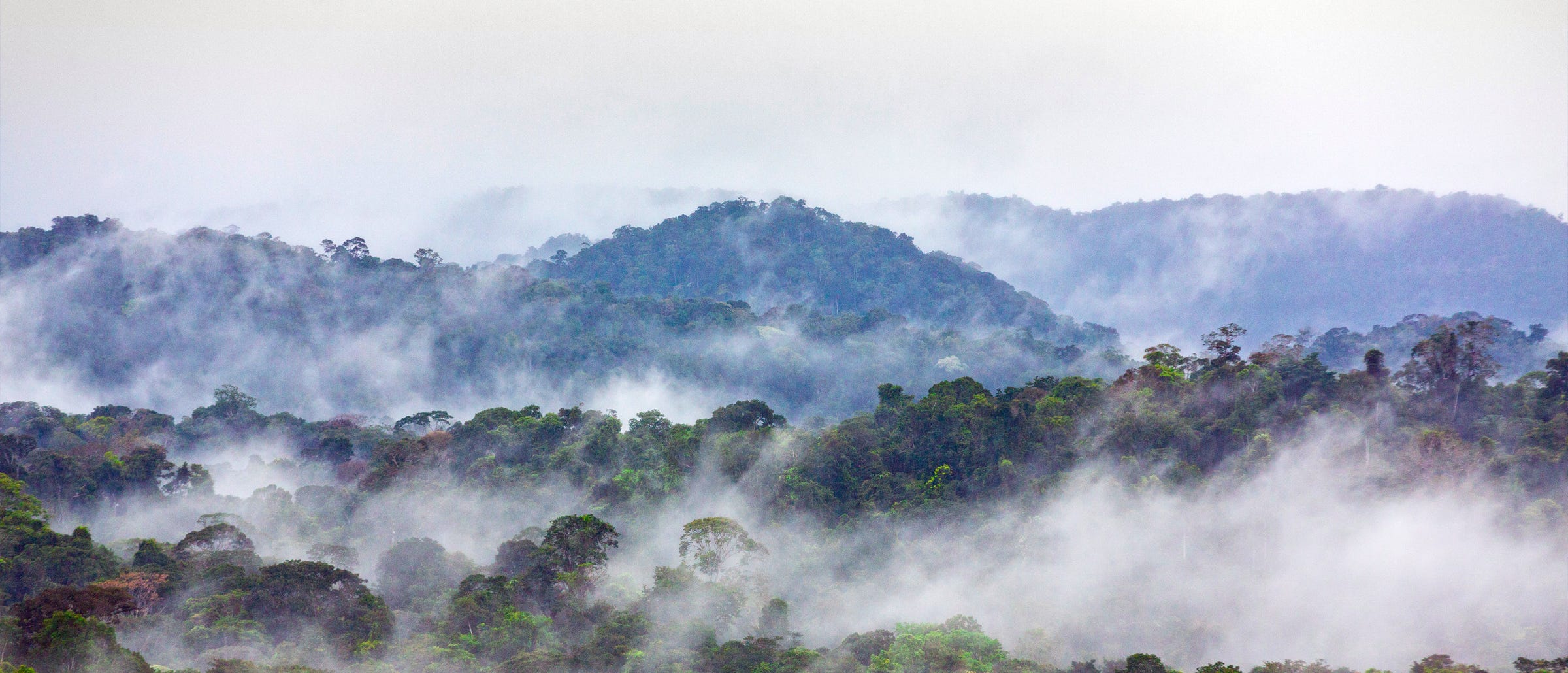
Rainforests are defined as dense, closed-canopy forests with exceptionally high rainfall and no dry season. They are among the most productive ecosystems on the planet and function as engines of global biodiversity.
The best-known rainforests are tropical, but some of the largest are located in cooler, temperate regions. Here are the seven largest rainforests in the world by estimated surface area:
7. Chocó-Darien
~187,000 sq km
The Chocó-Darien Moist Forest is a remarkably intact rainforest that runs along Colombia’s Pacific Coast and extends through the Darien Gap into Panama. It is one of the wettest places on Earth, receiving upwards of 9 meters (354 in) of rain annually.
The Chocó-Darien is home to around 10,000 plant species, 20% of which are found nowhere else in the world. Its marquee fauna is the Colombian Spider Monkey (Ateles fusciceps rufiventris). The extreme rain and challenging terrain have protected the region from economic development, sparing the forest but also locking the population into extreme poverty.
6. Valdivian Temperate
~248,100 sq km
The Valdivian is one of the world’s two great temperate rainforests. Located in Southern Chile, the forest is bounded by the Andes on three sides and the Pacific on the other.
This isolation gives the forest an insular biogeography that conserves an ancient Gondwanan character. As such, the flora and fauna are more closely related to that of Australia and New Zealand than to the rest of South America.
Lacking large predators, the Valdivian hosts a large radiation of miniature wildlife like the Pudu (Pudu puda), a 43 cm (17 in) tall deer species, and Monito del Monte (Dromiciops gliroides), a tiny mouse-size marsupial closely related to its Australasian cousins.
5. Pacific Temperate
~295,000 sq km
The world’s largest temperate rainforest extends from the coast of Northern California, into the Pacific Northwest of the United States, north into British Columbia in Canada, and then through to Alaska.
The forest is home to the famous Coast Redwood (Sequoia sempervirens)—the planet’s tallest and most massive tree. The Pacific Temperate has historically been heavily logged. Only tiny intact portions remain in its southern reaches, with progressively higher levels of preservation as one moves northwards.
The human geography of the forest is unusual. Most rainforests are in the developing world and marked by marginalization and high rates of poverty. The Pacific Temperate is located in one of the wealthiest regions on Earth, home to global brands like Nike, Microsoft, and—perhaps ironically—Amazon.
4. Borneo Lowland
~428,000 sq km
The Borneo Lowland rainforest is one of the world’s oldest; the island’s moat has allowed the ecosystem to exist relatively unchanged for 130 million years. Today, sadly, it is also among the most endangered.
Shared between Indonesia, Malaysia, and Brunei, the island of Borneo is about three times the size of the UK and is a treasure-trove of natural resources. Mining, oil extraction, and especially palm oil plantations have deeply fragmented and degraded the natural rainforest.
Indonesia has decided to place its new capital—Nusantara—on the fragile island, ensuring more development.
3. New Guinea
~786,000 sq km
The island of New Guinea is the second largest island in the world, after Greenland, and is split between Indonesia and the nation of Papua New Guinea. It hosts the third-largest rainforest on the planet.
Unlike the Congo and Amazon rainforests—which are dominated by large alluvial plains—the New Guinea rainforest is extremely mountainous. This terrain creates tiny micro ecosystems within each valley and a huge radiation of species.
The dense, fragmented forest also gave rise to an astonishing human radiation: it is the most linguistically diverse place on Earth and home to as many as 40 uncontacted tribes populated by human beings entirely unaware of modernity’s existence.
2. Congo Basin
~1,780,000 sq km
The second-largest rainforest in the world is shared between six nations: the Democratic Republic of the Congo (DRC), Cameroon, the Central African Republic, the Republic of the Congo, Equatorial Guinea, and Gabon.
The Congo Basin Rainforest contains a peat bog—the Cuvette Centrale—storing a massive 30 billion tons of carbon. If drained, this bog would emit greenhouse gas emissions equivalent to three years of global fossil fuel emissions. More than any other rainforest, our climate depends on keeping the Congo forest intact.
The Congo Basin also conserves incredible African fauna, including all three species of Great Ape, the African Forest Elephant (Loxodonta cyclotis), and the giraffe-like Okapi (Okapia johnstoni).
1. Amazon
~5,500,000 sq km
The largest rainforest on Earth has become synonymous with the ecosystem itself. Shared between Brazil and spanning eight other countries—the Amazon covers 35% of the South American continent.
The Amazon sprawls upon the alluvial plain of its namesake Amazon River, which cuts through the forest like an anaconda. It is home to half the remaining tropical rainforest in the world and 10% of all global species.
The Amazon is threatened with deforestation from cattle ranchers and soybean farmers. Its fortune waxes and wanes to the rhythms of Brazilian politics—with left-wing governments more likely to enforce conservation rules.
Earthview is a reader-supported publication devoted to climate change and the environment. Please consider a paid subscription to support the work we do and access premium content.