


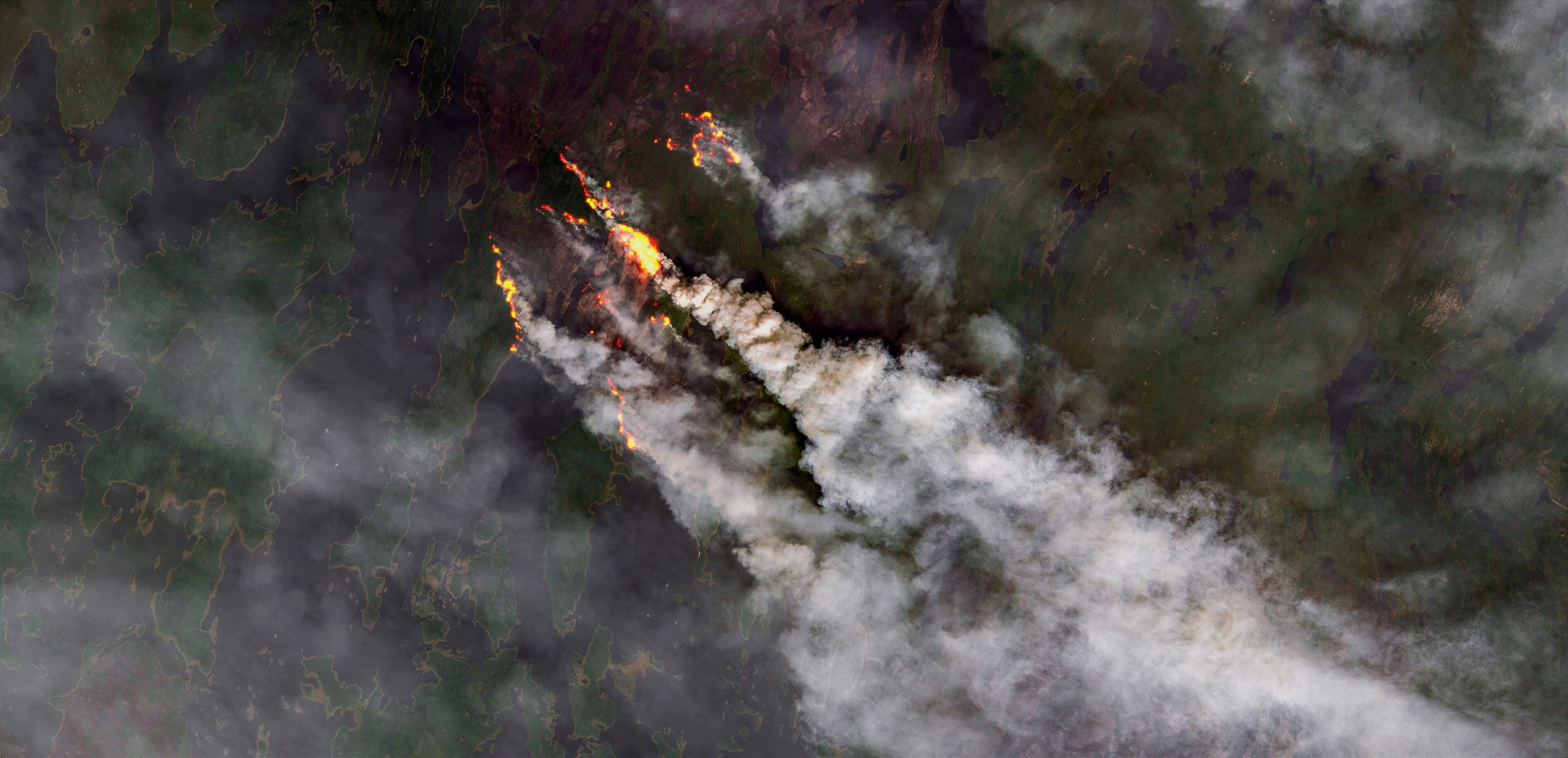
Over the weekend, several North American cities vied for the title of the worst air quality in the world thanks to wildfires burning (mostly) in Canada’s boreal forests.
The experience is jarring for those who—like me—grew up not long ago in North America's eastern half and never once experienced such a phenomenon. It is now an annual occurrence.
This dramatic, highly visible environmental change within the span of a single lifetime has given rise to a slew of misinformation and conspiracy theories. Here are the top five myths about these “Canadian” wildfires debunked:
5. They’re All Canadian
Although typically labelled “Canadian” by the media, the wildfires dumping smoke into populous eastern cities are best thought of as a “North American” phenomenon. The United States and Canada share a political border that natural ecosystems and wildfires tend to ignore.
While most of the attention has been on Canada, wildfires have also been burning this past week in northern Minnesota. The majority of wildfire smoke in Minnesota over the past week has been locally generated, and this smoke also contributed about one-fifth of the total smoke across the rest of the continent.
Earthview is a reader-supported publication devoted to climate change and the environment. Please consider a paid subscription to support the work we do and access premium content.
4. Immigrants Are Setting the Fires
One very commonly circulated conspiracy theory attributes the increasing incidence of wildfire in Canada to arson. Although rarely stated as such, the very strong implication of this narrative is that Canada’s changing demographics are to blame. In this alternative right-wing reality, the problem isn’t climate change: it’s migrant crime.
This theory has no basis in reality. Most wildfires are ignited by lightning strikes, and such fires account for the great majority of the area burned.1 Although human activity is an important secondary ignition source, these ignitions are typically accidents, not arson. There is no evidence that a significant percentage of the 2026 Canadian wildfires were started intentionally, nor that arson has increased in the last decade.
Indeed, the very idea strains credulity. Canada’s boreal forest is a vast, isolated region larger than the European Union. Few road links traverse it. The idea that immigrants from Toronto are driving to Yellowknife, hiring an aircraft, skydiving into the wilderness, starting massive wildfires, and then somehow escaping the area before engulfing themselves in flames (helicopters?) is absurd.
3. Canada Stopped Managing Its Forests
Another persistent myth is that the Canadian wildfires are the result of the Canadian government’s poor forest-management practices. In this revisionist narrative, Canada once actively managed its forests using controlled burns—until the 1990s when it went woke and stopped these measures under pressure from environmentalists. Now the nation is reaping the consequences of left-wing green politics run amok.
This narrative is almost laughably false. In reality, Canada has never actively managed the wide swath of boreal forests that are currently burning. The vast majority of Canada's forests are located extremely far away from roads and other infrastructure needed to pursue active management. And the sheer size of them—larger than France, Italy, Spain, Germany, Poland, and Scandinavia combined—makes managing them effectively impossible.
Additionally, it has historically been unnecessary to prevent or even fight these wildfires, as in the past they were much smaller, generated much less smoke, and only rarely threatened population centers.
In the future, Canada should indeed do more to prevent the dangerous levels of smoke these fires now create. But that would be an act of climate change adaptation, not an acknowledgment that its historically passive wildfire policy—which was perfectly suited to a pre-industrial climate—was incorrect.
2. America Can Fix It
In the aftermath of this year’s wildfires, there is one thing all right-wing commentators have agreed upon: this would never happen in America. America—unlike Canada—knows how to prevent and fight wildfires. Some have even renewed calls for the United States to annex Canada, so as to “fix” its wildfire problem.
Of course, wildfires do happen in the United States. They tend to be highly seasonal and vary from year to year. Yet as recently as 2022, the acreage lost to wildfires in the US was twice as large as that in Canada. This is despite Canada being the larger of the two countries, having a higher percentage of forest cover, and its forests being far more remote.
There is no indication that the United States would be any better than Canada at managing the issue.
1. Climate Change Isn’t the Cause
Most of the conspiracy theories and myths regarding Canada’s wildfires have a singular purpose: to propagate any plausible explanation—other than climate change—that might explain their increasing intensity.
But climate change is the explanation. The science could not be clearer: as the climate gets hotter and drier, wildfires grow larger.2 And larger wildfires naturally create more smoke. This simple fact cannot be explained away. And the only remedy is the phase-out of fossil fuels and other human activities that contribute to climate change.
Earthview is a reader-supported publication devoted to climate change and the environment. Please consider a paid subscription to support the work we do and access premium content.
